
 enthusiasm: a strong excitement or feeling, something inspiring zeal or fevor, borrowed from the Greek word “enthousiasmos” meaning “inspiration or possession by god.” (Merriam-Webster)
I had a dream in which a colleague was reading a book titled, “The Enthusiastic Organization of the Self.” Introducing novel ideas is not an unknown function of dreaming. In my own case, thinking about the organization of the archetype of the Self and pulling in the idea of “enthusiasm” was intriguing.
In Jungian psychology, the construct of Self (with a capital ‘S’) is described as a central archetype, an organizing center that helps to form the personality through both conscious and unconscious processes. According to Carl Jung, archetypes are innate, like instincts, but continue to transform as we move through life gaining new experiences. The Self helps to both push and pull us toward wholeness and can be viewed as the organizer of Jung’s concept of individuation or development throughout the lifespan.
The Self can be viewed as a part of nature functioning like a seed, an oak seed, for example. The seed has the biological material necessary for it to grow into an oak tree. However, to grow and become the majestic oak tree, the seed needs soil, water, and an environment that supports its growth. Without these things, the seed will not have much of a chance to reach the “majestic” part in the life of the seed, sapling and then tree.
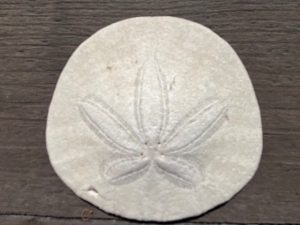
In dreams, the Self can be represented by a vast assortment of imagery, but Jung wrote of the circular mandala as a common representation of the Self. The image posted with this article found at the beach in Central California is a Sand Dollar, which has a round shape and intricate center so it is fitting Self imagery.
The idea of “enthusiasm” as it is related to the organization of the Self, is not like having a cheerleader perched on our shoulder. Rather, it is more like having a warrior perched there. The same type of energy or life-force that guides the seed and sapling to find its way through cracks in concrete, is the same type of life-force that the organizing principle of the Self can have–we could say that the process can be almost “enthusiastic.”
There are many examples of this organizing principle in nature and in dreams. A dream series can present chaotic imagery followed by beautiful, organized, story-like scenery, pulling together disparate day and ego “debris.” A close friend had a medical diagnosis assumed to be fatal. In a time span of several months, not years, the latest tests revealed the problem cleared giving him a renewed lease on life. I am not saying that the Self performed a miracle, but rather, that an intricate dance, “enthusiastic in nature” helped to guide my friend through his illness. The same organizing principle also helps guide us through end-of-life processes and to death.
In his classic Jungian book, “Archetype Revisited: An Updated Natural History of the Self,” Jungian analyst Anthony Stevens (2003) writes of an idea he called the “frustration of archetypal intent.” Stevens’s idea illustrates the dichotomy of the Self. On the one hand, there can be something like an “enthusiastic” nature to the Self’s organizing function in a life, but on the other hand, if not actualized, there can be something like a “frustration.” This frustration can lead to trouble, manifesting in a myriad of ways, but can include psychological symptomology, behavior problems, meaningless, etc.
Mental health professionals see this “frustration” in clients born and raised in poverty, for instance, and in spite of guidance from the Self, can be pulled back into the grips of poverty and destructive behavior from group pressure from gangs, for example.
The psyche is not naive. Though there can be an enthusiasm-like zeal of Self imagery, the psyche also takes into consideration current conditions and can sometimes guide us anyway even through outwardly appearing impossible situations.
I dreamed of a circular “bullseye” when confronted with a seemingly unsolvable life-problem. The dream helped me to see the problem differently and helped to visualize a way through the problem and the bullseye imagery provided by my psyche was the perfect image. The dream and image were more than that. It helped me to look at the problem with a new attitude seeing it as more of a challenge helping to provide the energy needed and inherent excitement to assist with navigating what was first viewed as an oppressive circumstance.
Through imagery, and other archetypal expressions of the unconscious, the enthusiastic organizing nature of the Self can be glimpsed “a priori” and perhaps more clearly “a posteriori.” We can find this organizing principle working in arenas of inner and outer life, manifesting in health challenges, in relationship, sport, politics, parenting and work, for instance.
The Self, of course, is a psychological construct posited by Jung, but “inspiration or possession by god,” as Merriam-Webster defines “enthusiasm,” is an apt expression, I believe, for the inner operations of the Self. The obligation for us is to take this enthusiasm-like gift to heart and to live authentically especially when life puts up a challenge.
Stevens, A. (2003). Archetype Revisited: An Updated Natural History of the Self. Inner City Books: Toronto.
Recent Comments